Big moments
Stories for kids who won’t sleep in their own bed (yet)
Your child wants you there until they drift off, climbs into your bed in the middle of the night, or still sleeps in your room, and you’d like that to change? Sleeping alone is something kids learn, at their own pace. Here’s what your child may be feeling at each age, gradual steps, a story to share during the day, and signs that it’s time to ask for help.
· By the Child Fiction team
What your child may be feeling
At night, sleeping alone means being apart from you for hours. For a young child, it’s a real step toward independence, and they may be torn between wanting to be a “big kid” and needing to feel you close by. Sharing a bed or a room is a choice each family makes for itself: this page is for parents who have decided to move toward separate nights, with no judgment about what came before.
- Ages 3 to 4: saying good night is often the hardest part of the day. Imagination is taking off, night fears start to show up, and you’re still their safe place.
- Ages 5 to 7: they can understand a plan and commit to it, especially if they help make the decisions. They may also feel a little embarrassed about still coming into your bed, and hide it behind an “I’m not tired.”
- At any age: a big change, like a new baby, a move, or starting school, can bring back the need to feel you close, even in a child who was already sleeping alone.
Gentle steps, one at a time
- Pick the right moment. Try not to start right before a birth, a move, or the first day of school: one change at a time. Announce the plan a few days ahead, with a date your child can look forward to.
- Make their bed a place that feels like theirs. Let them pick the sheets, where their stuffed animal sits, a soft night-light. Spend time there during the day, too: reading, playing, building a fort.
- Keep your usual bedtime routine, calm and always in the same order. Our page on fear of the dark goes over that routine and the little lights that help.
- Tell them where you’ll be. “I’m going to clean up the kitchen, read for a bit in the living room, then go to bed in my room, right next door.” A child who knows where you are, and recognizes the familiar sounds of the house, feels less alone.
- Move away little by little. At first, sit on a chair next to the bed until they’re asleep; then, every two or three nights, move the chair a bit closer to the door, until you’re out of the room.
- Try a bedtime pass. Once they’re in bed, your child gets one pass, good for one call-out or one trip out of the room (a glass of water, one last hug): they hand it to you, and that’s it for the night. A pass saved until morning can even become a small point of pride.
- At night, walk them back calmly to their own bed, without bright lights or long talks, as many times as it takes. Agree ahead of time, between the grown-ups, on what you’ll do if they show up at 3 a.m., so you respond the same way every night: consistency matters more than firmness.
- Celebrate progress in the morning, even small wins: a whole night in their bed, but also going back to bed without tears.
A story to talk about during the day
A story where a character discovers nights in their own bed lets you bring up the subject with no pressure: nobody is watching your child, everyone is watching the hero. Read it during the day or early in the evening, when your child feels like chatting about it, and keep the last read at bedtime soft and low-key. The goal is to talk, not to turn bedtime into a lesson.
Jade and the Five Minutes
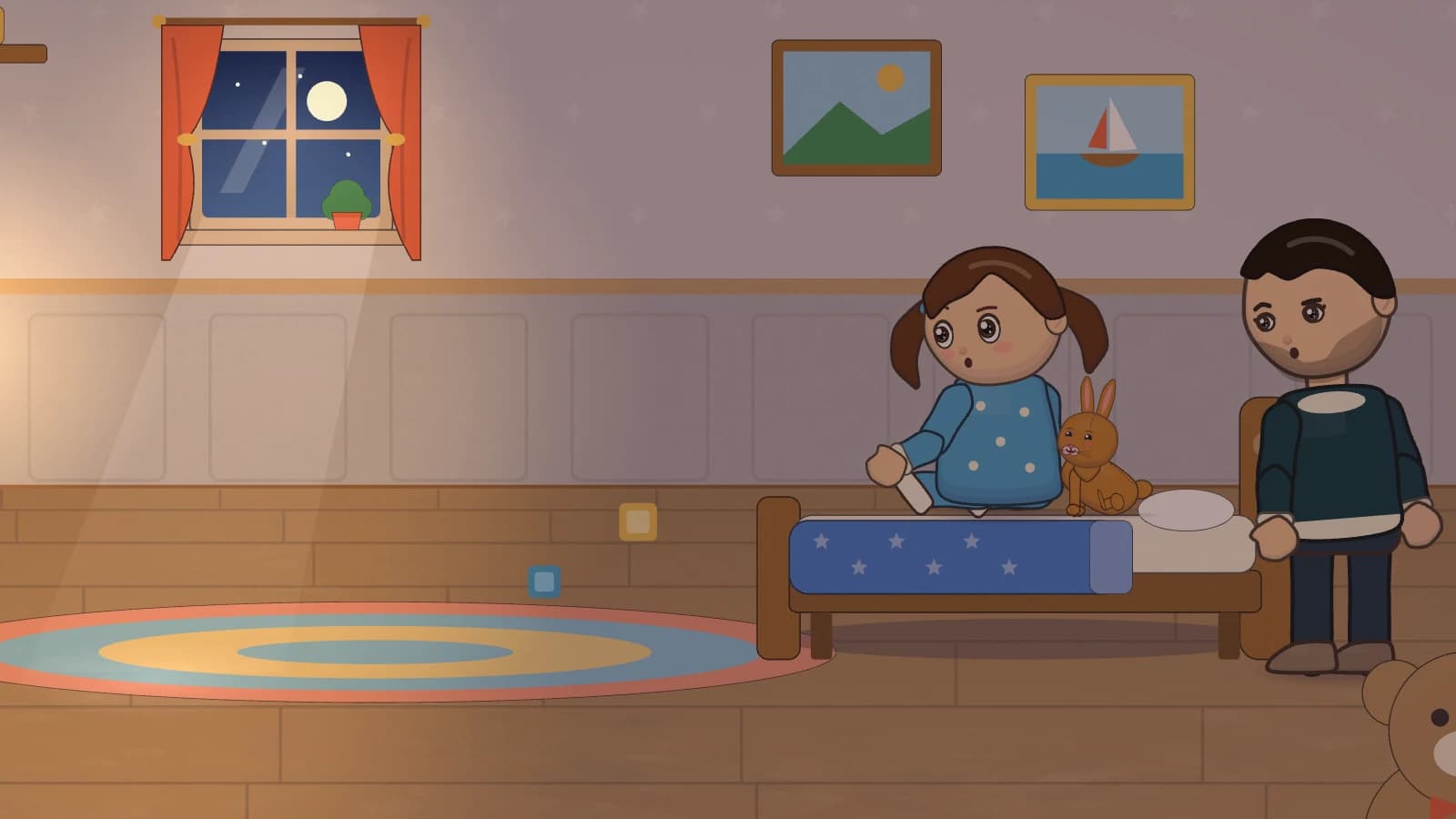
That night was Jade’s first night in her very own bed, for real, all night long. She had picked the comforter with the stars and set Pom-Pom, her bunny, against the pillow with his ears standing straight up. “Pom-Pom is on guard duty,” she explained.
Dad read the story, gave her a hug, then stood up. “I’ll come back to check on you in five minutes.” Jade frowned. “Is five minutes long?” Dad smiled. “Just long enough to tidy up the kitchen and come back.”
Jade listened. Plates clinking. Water running. The cupboard door closing. She held Pom-Pom tight and watched the night-light paint a moon on the ceiling. And then, just as she was about to call out, soft footsteps came down the hall.
Dad poked his head around the door. “See? I came back.” Jade smiled, her eyes already half closed. “Pom-Pom was really brave,” she murmured. The next time Dad checked in, Jade was asleep, one arm around her bunny.
Questions to talk about together
- Why does Jade ask if five minutes is long?
- What does Jade hear while her dad tidies the kitchen? Why do you think those sounds make her feel better?
- Why does she say it was Pom-Pom who was brave?
- What would help you stay in your bed all night?
On Child Fiction, you can create an animated story where your child, with a favorite stuffed animal or family members, goes through their first nights in their own bed: choose the “Sleeping in their own bed” moment, and the story always stays gentle. Watch it together earlier in the day; in the evening, it’s time to read, for instance one of our free bedtime stories, written to be read aloud.
Common questions about sleeping alone
At what age can a child sleep alone?
There’s no single age: it depends on the child, their temperament, and your family’s choices. Some kids get there early, others need more time. What matters is moving in small steps, at a calm moment, and staying consistent from one night to the next.
My child comes into our bed every night. What should I do?
If you’d like that to change, walk them back to their own bed, calmly and every time, with few words. Stay with them for a moment if they need it, then leave. It takes energy at first; consistency usually pays off within a few weeks.
What if my child is scared of the dark?
Deal with the fear first, by listening without teasing. Our page on fear of the dark has simple ideas for bedtime and a story to share.
Should I use a reward chart?
A sticker chart can motivate some kids from around age 4, as long as it rewards effort (staying in bed, going back to bed calmly) rather than a perfect night. For younger kids, your pride in the morning is often reward enough.
When to ask for help
If your child is very anxious about being apart from you, during the day as well, if nights stay very disrupted for several weeks despite your efforts, if they snore a lot, or if they seem tired during the day, talk to your pediatrician or family doctor.
Keep reading
- Stories for kids who are scared of the darkA calm routine, a night-light, words to name the fear: ideas and a story to help you talk with your child about being scared of the dark, without teasing.
Who’s Making That Noise?
Tap, tap… Hoo, hoo… Glug, glug… Snuggled in bed, Maya hears some funny noises. So she grabs Caramel, her bunny, and her flashlight, and decides to investigate.Ages 3 to 85-minute read7-minute listen- Stories about self-confidence for kids: trying, slipping up, and trying again“I’m bad at everything”: what to say, how to help your child try, slip up, and try again, plus a shoelace story and questions about self-confidence.
- Short bedtime stories to read aloud or listen to togetherShort, illustrated bedtime stories for kids ages 3 to 8, to read aloud or listen to with the screen off, with questions to talk about. Free, no sign-up.
- Personalized stories for kids: books, audio, or animated?Printed books, audio, apps, or animated stories: how to choose a personalized story with your child’s name and family, while keeping their privacy safe.