For parents
Our approach: calm, shared, limited screen time from age 3
Child Fiction is watched on a screen, and we won’t pretend otherwise. We’re also not trying to get your child to spend more time on it. We set out to build calm, shared, limited screen time for kids 3 and up: here are our commitments, the official advice they line up with, and what we don’t promise.
· By the Child Fiction team
Advice about kids and screens has changed a lot in recent years, and it isn’t the same everywhere. The American Academy of Pediatrics (AAP) replaced its media guidance in January 2026, with more weight on what children watch and who they watch with. France goes further: since 2025, its official child health record rules out screens before age 3 and asks that, from 3 to 6, they remain the exception. We started from the stricter side and designed every detail so that Child Fiction stays a short, chosen, shared moment.
Our nine commitments at a glance:
- Designed for ages 3 to 8: never before age 3.
- Made to watch together: the people they love on screen, you right beside them.
- Calm pacing, soft visuals: no mini-games, no points to earn.
- No ads, no autoplay: no story starts on its own.
- A real ending, a known length: about 4 to 8 minutes, depending on age.
- A limit you set: per day, in child mode.
- Never right before sleep: evenings are for reading.
- Choices that matter: stories to talk about together.
- Alongside books, never instead of them.
Our commitments
Each commitment below describes a design choice and the public advice it lines up with. No organization has endorsed or reviewed us: these choices are our own, and we stand behind them.
1. Designed for ages 3 to 8
Child Fiction is designed for kids ages 3 to 8: each story is written for ages 3–4, 5–6 and 7–8, and older kids will likely find them too young. We recommend waiting until your child turns 3 before creating their profile. WHO advises against any sedentary screen time before age 2, and French guidance rules out screens entirely before 3; we follow the stricter rule. Until then, books, songs and stories told out loud are worth far more.
2. Made to watch together
Our stories are meant to be watched side by side: familiar faces on screen, choices to talk over, questions that come up on their own. The AAP’s 2026 policy encourages caregivers to join in, by watching together and talking about what kids see. A 2020 review of 42 studies also ties watching together to stronger language skills: a modest correlation, not proof of cause and effect, but it points the same way.
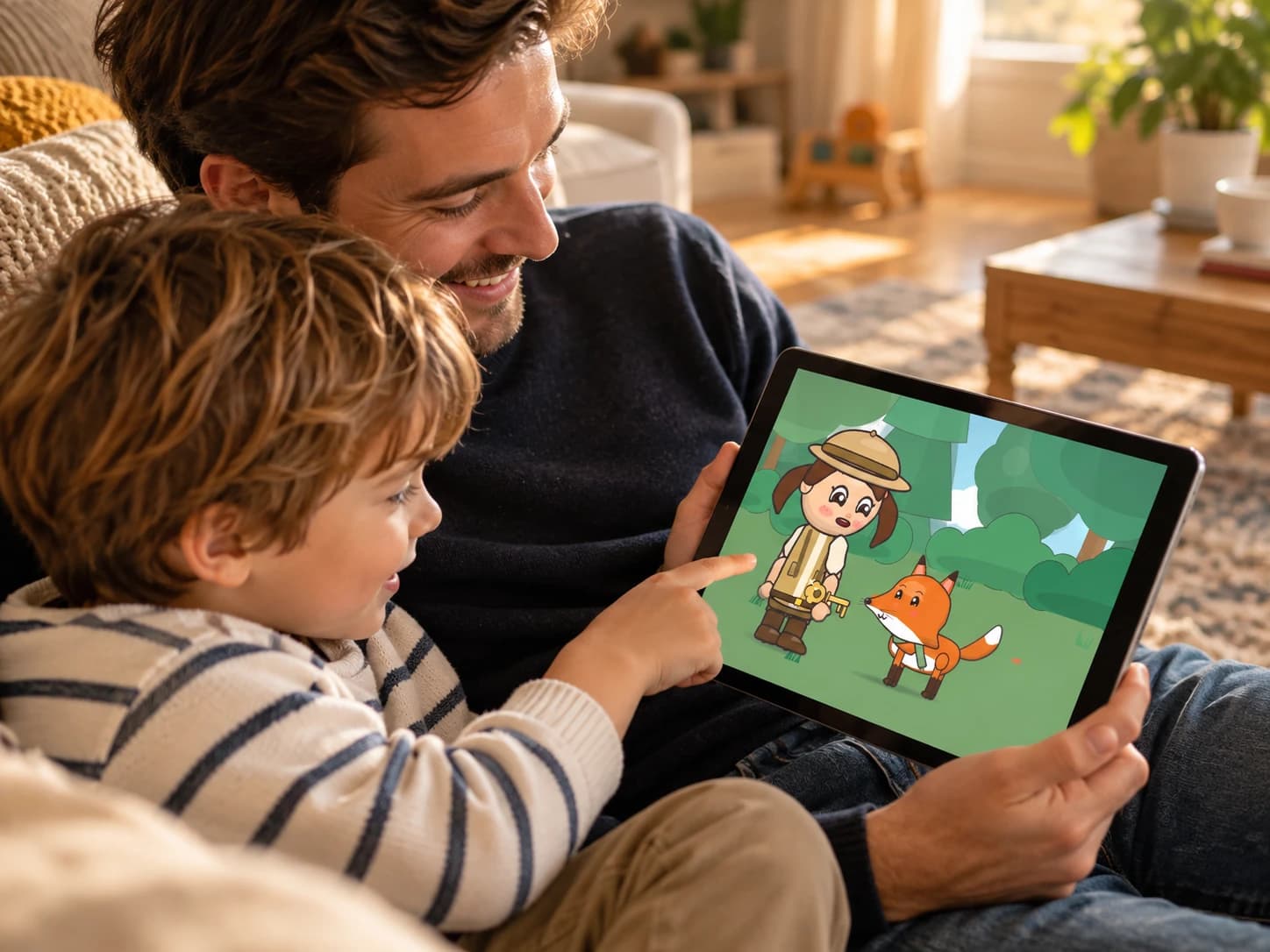
Once in every story, the hero also turns to your child and asks them a question to answer out loud: the story waits a moment, then goes on whatever the answer, and nothing is recorded.
Child mode lets your child start their own stories without reaching your settings. It doesn’t replace you: French guidance asks for an adult to be there every time between ages 3 and 6.
3. Calm pacing, soft visuals
Our stories move at the pace of the narrator’s voice. For the youngest, sentences are shorter and choices are fewer and simpler. Sets and characters have the look of a picture book, with rounded shapes and soft shading, and the music stays light.
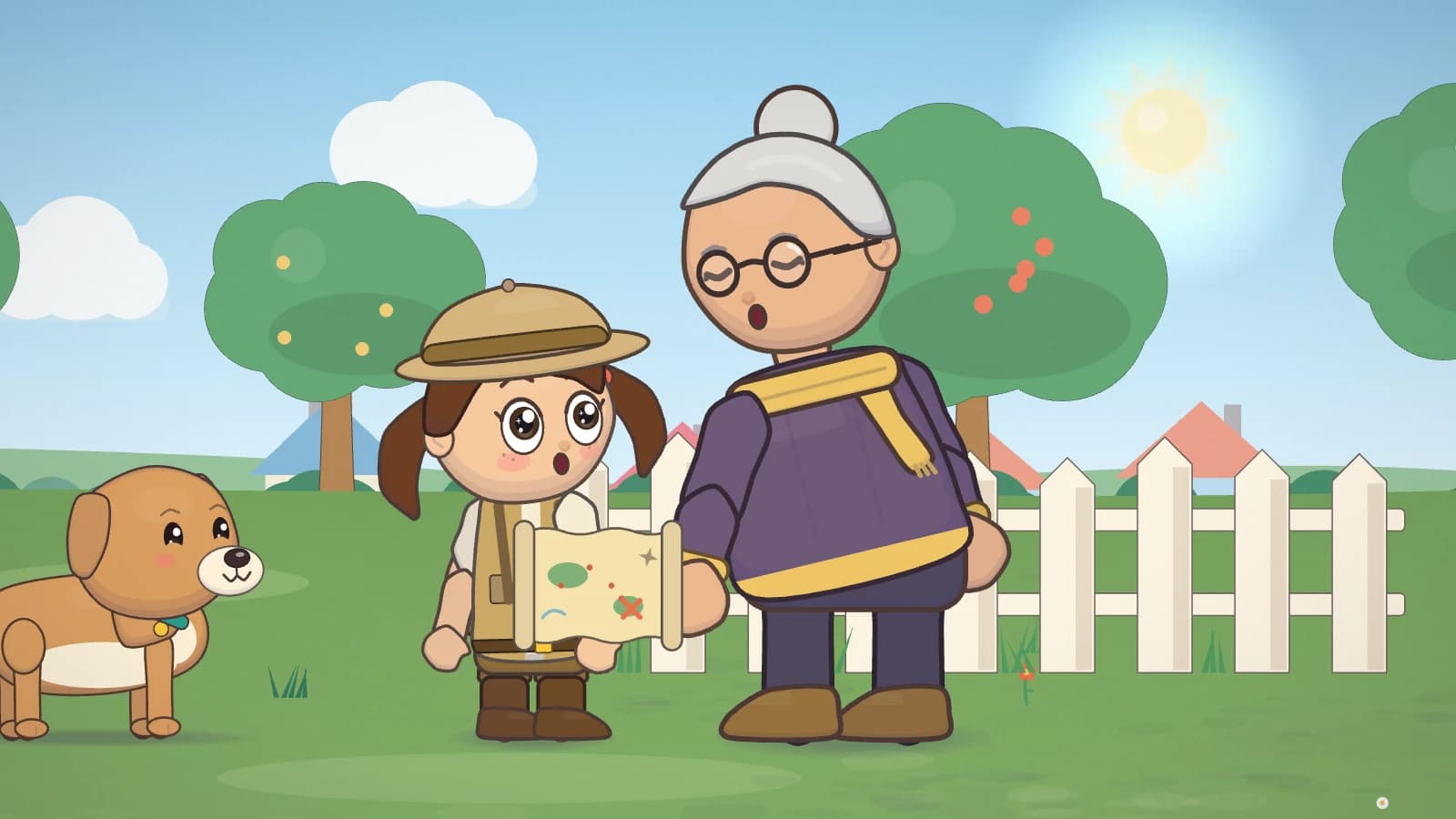
During the story, there are no mini-games, no points to earn and nothing to tap, only questions asked at the right moment: the hero’s, and, in stories with choices, the one that decides what happens next. A review of 43 studies on children’s digital storybooks found that animation, music and sound that fit the story helped comprehension a little, while interactive gimmicks tended to distract kids.
It’s a design choice made for your child’s comfort, in line with the AAP: its 2016 guidance already advised avoiding fast-paced programs for young children, and its 2026 policy links low-quality, fast-paced content to more hyperactivity symptoms in preschool boys. It is not a promise about your child’s brain: more on that below.
4. No ads, no autoplay
Child Fiction shows no ads, to kids or to parents, and no analytics tools load in the family space or in child mode. No story plays after another on its own: at the end, “The end” stays on screen, and you, or your child, decide what comes next. There’s no endless feed either: each story is requested one at a time, and each one uses a free story or credits.
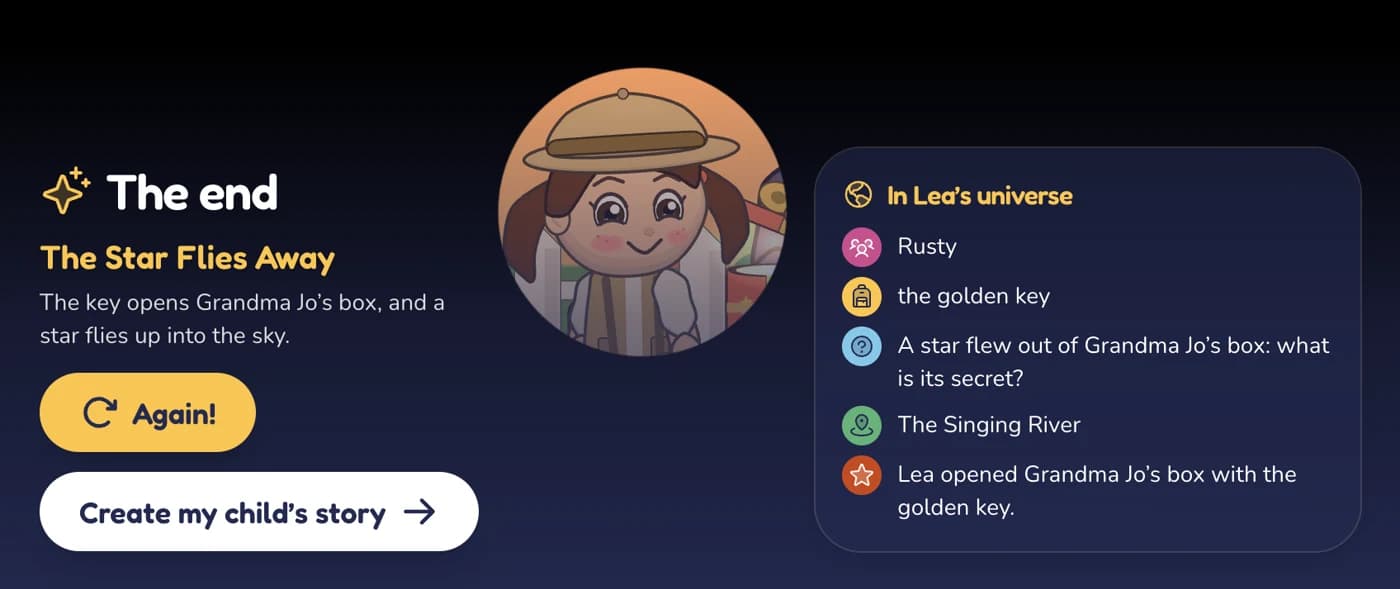
The AAP points out that autoplay and endless scrolling make it hard to stop, and a French expert commission (2024) lists both among problematic designs. Earlier AAP guidance (2016) also called advertising to young children unethical.
5. A real ending, a known length
Every story has a beginning, a middle and an end, and runs about 4 to 8 minutes depending on age: you see its length before you start it. ZERO TO THREE, an early childhood nonprofit, suggests choosing shows with exactly that: a clear beginning, middle and end. Knowing the length ahead of time also makes it easy to announce the plan: “One story, then we go play outside.”
6. A limit you set
In parental controls, you can set a daily limit for child mode; once it’s reached, child mode suggests a break until the next day. We won’t tell you any daily amount is “recommended.” WHO sets a maximum of one hour a day for ages 2 to 4 and adds that less is better; the AAP’s 2026 policy says limits might range from under an hour a day for preschoolers to one to two hours or more of entertainment media for school-age kids.
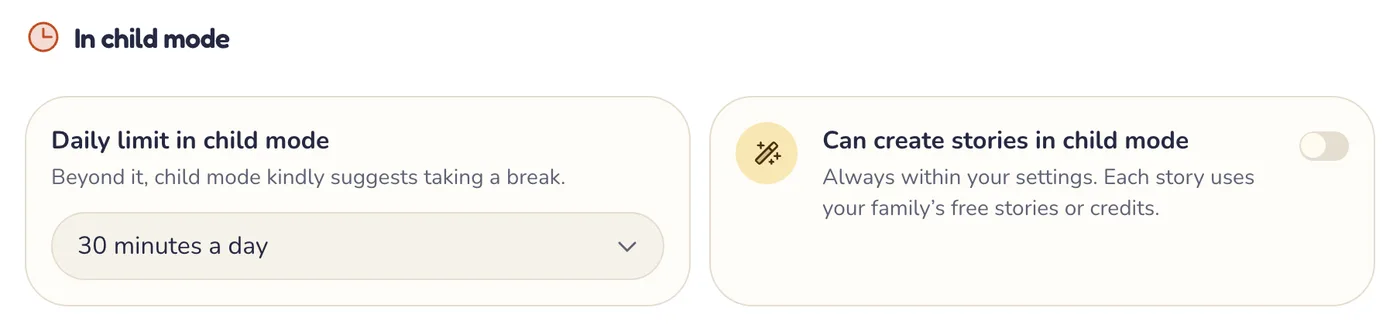
For younger kids, a few stories a week, chosen and watched together, fit that advice better than a daily habit. The AAP’s “5 C’s” also invite parents to think about what screen time crowds out: family time, sleep and time outdoors.
7. Never right before sleep
Our animated stories aren’t meant for bedtime, even when the story itself takes place at night. The AAP advises no screens in the hour before bed, and French guidance says the same. Watch them together earlier in the day; at night, it’s time for reading. That’s why our free bedtime stories are texts to read aloud, with no screen in front of your child.
8. Choices that matter, stories to talk about
In stories with choices, your child decides what happens next, and those decisions leave a mark on their universe: a mystery left along the way finds its answer in a sequel. We want the story to be a starting point for conversation: why did you pick that? What would you have done? Researchers found that asking 5- and 6-year-olds to explain parts of a story helped them draw a general lesson from it, sometimes more than simply telling them the moral. Our values pages offer questions for each value.
9. Alongside books, never instead of them
Nothing replaces a book read on a grown-up’s lap. A review of 39 studies found that an adult reading a print book with a child did better, for comprehension, than enhanced digital books used by the child alone, and the AAP encourages reading together often, from birth through at least kindergarten. Child Fiction is an occasional extra, never a replacement for reading together.
What we don’t promise
Because your trust matters more than a sales pitch, here’s what you’ll never read from us.
- That Child Fiction is good for your child’s brain or attention. Research on cartoon pacing is mixed: a 2011 study of 60 four-year-olds found lower scores on focus and self-control tasks right after 9 minutes of a very fast cartoon, but a 2015 follow-up pointed to fantastical events rather than pace, a 2019 study found that fantastical stories actually improved self-control, whatever the pace, and a 2024 review calls the results contradictory. Our stories include magic and imaginary characters: the calm pace is a design choice, not a promise.
- That our stories teach sharing, bravery or honesty. A story can open a conversation; what matters is what you talk about together. Our guide to values and stories shows how to use a story to start that conversation.
- That they’re made for bedtime. At night, it’s time for reading.
- That they replace professional help. If a fear or a struggle lasts, or gets in the way of daily life, talk to your child’s doctor or a child psychologist.
- That any health organization, pediatrician or expert endorses us. Our choices line up with public guidance; no one has signed off on them for us.
- That screens are fine for kids under 3. The guidance we follow advises against them.
To pick other calm shows beyond Child Fiction, our guide to low-stimulation shows walks through what to look for.
Keep reading
- How Child Fiction works, step by stepYour child’s profile, family characters, picking a story, watching together: how Child Fiction makes an animated story for your child.
- Low-stimulation shows: how to choose calm screen time for preschoolersSlow pacing, soft sound, a real ending, no ads: how to spot calm, low-stimulation shows for kids ages 3 to 6, and what pediatric guidance actually says.
- Safety and privacy: how we protect your childMinimal data, optional photos deleted after use, no ads, a PIN-protected child mode: how Child Fiction keeps your family safe.