Values
Stories about being brave: trying even when you’re a little scared
A 4-year-old’s bravery doesn’t look like a fairy-tale hero’s. It looks like saying hi to a new teacher, tasting an unfamiliar food, or raising a hand in class. Here’s what bravery looks like at each age, a short story excerpt, and questions to talk about it with your child, without ever pushing.
· By the Child Fiction team
Being brave doesn’t mean not being scared
For a child, bravery often starts with a fear they can name. Telling them “You’re not scared, you’re a big kid” asks them to hide what they feel. Telling them “You feel a little scared, and you’re trying anyway” shows them the two can go together. Bravery grows in small steps, at their own pace, with a trusted grown-up nearby.
Ages 3–4: so many firsts
Everything is new: preschool, the big-kid slide, the neighbor’s dog, talking to Grandma on the phone. At this age, being brave often means staying, watching, and then moving a little closer. Stay close without pushing: “I’m right here. Tell me when you’re ready.” And celebrate the small step, not the result.
Ages 5–6: going for it in front of others
Putting their face in the water at swim lessons, singing a song in front of the class, asking a librarian for help while you stand nearby: now other people are watching. Your child can get ready for these moments with you: practice what to say, imagine what might happen, and agree on a secret signal that means “I need you.”
Ages 7–8: the courage to speak up
Bravery becomes a matter of words, too: saying “Stop it” when a classmate is being picked on, owning up to a mistake, sticking with an idea the group doesn’t share. That can be harder than jumping off the high dive! Talk about it using the situations your child tells you about, without judging.
Everyday situations
- A first day somewhere new (day camp, a dance class): visit ahead of time, describe it in simple words, and tuck a small comforting object into their pocket.
- Ordering their own ice cream: your child practices the words with you in line, then says them to the person at the counter. You’re right behind them.
- Tasting a new food: one tiny bite is enough. It’s OK not to like it, and to try it again another day.
- A sleepover at Grandma and Grandpa’s: a favorite stuffed animal, a family photo, a little bedtime routine that feels like home.
- Disagreeing with a friend: act it out at home with stuffed animals, taking turns playing each part.
A story excerpt to read together
Ordering at the bakery all by yourself can feel like climbing a mountain. Read this passage slowly, without commenting right away: your child needs a moment to step into Leo’s shoes. To go further, Noah and the High Diving Board tells another first leap, in full and for free.
Leo at the Bakery
That Saturday, Dad stopped in front of the bakery and handed Leo a few dollars.
“Want to be the one who asks for the muffins today?”
Leo looked at the window, at the golden muffins, at the lady in the blue apron behind the counter. His heart was beating fast, like when he runs across the backyard.
“Will you come with me?”
“I’ll be right behind you,” said Dad.
In line, Leo whispered to himself: “Two blueberry muffins, please. Two blueberry muffins, please.” When it was his turn, his voice came out very small. The lady leaned over the counter to hear him better.
“Two blueberry muffins, please!” Leo said again, a little louder this time.
The lady smiled and handed him a paper bag, still warm. On the sidewalk, Leo carried it like a trophy. Then he sat down on the bench next to Dad, and they each had a muffin, to celebrate.
Questions to talk it over
Help your child put words to what Leo feels, then to what they feel themselves. Leave room for silence: they’re thinking.
- Why do you think Leo’s heart was beating so fast?
- What helped him ask for the muffins, even though he felt a little scared?
- How did he feel walking out of the bakery? Why do you think he wanted to celebrate with Dad?
- What’s something that makes you feel a little scared, but that you’d like to try anyway?
Tips for parents
- Make room for the fear: “It’s OK to feel scared.” Never tease a child for being afraid, even gently, even to lighten the mood.
- Break it into small steps: look at the pool, then sit on the edge, then wade in up to the knees. Every step counts.
- Get ready together: practice what to say, visit the place, act out the scene with stuffed animals or action figures.
- Share your own fears: a time you were scared and tried anyway, and what it gave you.
- Notice the effort: “Your voice was a little shaky, and you asked anyway” rather than “See, that was nothing.”
Why a story helps you talk about it
A story gives your child a little distance: they watch a character feel scared and then go for it, without being in the spotlight themselves. The Clay Center for Young Healthy Minds at Massachusetts General Hospital points out that night fears are very common between ages 4 and 12, and warns that some classic tales can frighten young children: comforting stories are the better pick. In the stories and excerpts on these pages, we choose to show what bravery brings (pride, a shared moment) rather than what happens when you don’t dare. After reading, imagine what comes next together: “What could Leo’s next small step be? What about yours?”
Bravery isn’t a contest: some kids jump right in, others watch for a long time before they dare, and both are normal. If a fear lasts, grows, or gets in the way of daily life (going to school, sleeping, playing with others), talk with your child’s doctor or a child psychologist. For bedtime worries, see our page on kids who are scared of the dark, and for the bigger picture, our guide to values and stories.
Common questions
How can I help a fearful child feel braver?
Start by acknowledging the fear, then offer very small steps, with you close by at first. Prepare for new situations (a visit, practice, role-play) and notice every effort. Avoid comparing them with a sibling or a friend “who isn’t scared of anything.”
Should I push a shy child to join in?
Encourage, yes; push, no. A shy child often needs to watch before joining. Arrive a little early to a party, stay close for the first few minutes, and give them a specific job (handing out cups, for example): that’s often easier than “going to play with the others.”
What are good stories about being brave for preschoolers?
Plenty of classic tales are about bravery, but some feature wolves, giants, or dark forests that can worry young kids. For little ones, choose an everyday story where the hero works up to something one small step at a time, like Noah and the High Diving Board (ages 4 and up), and save the more dramatic tales for daytime.
Keep reading
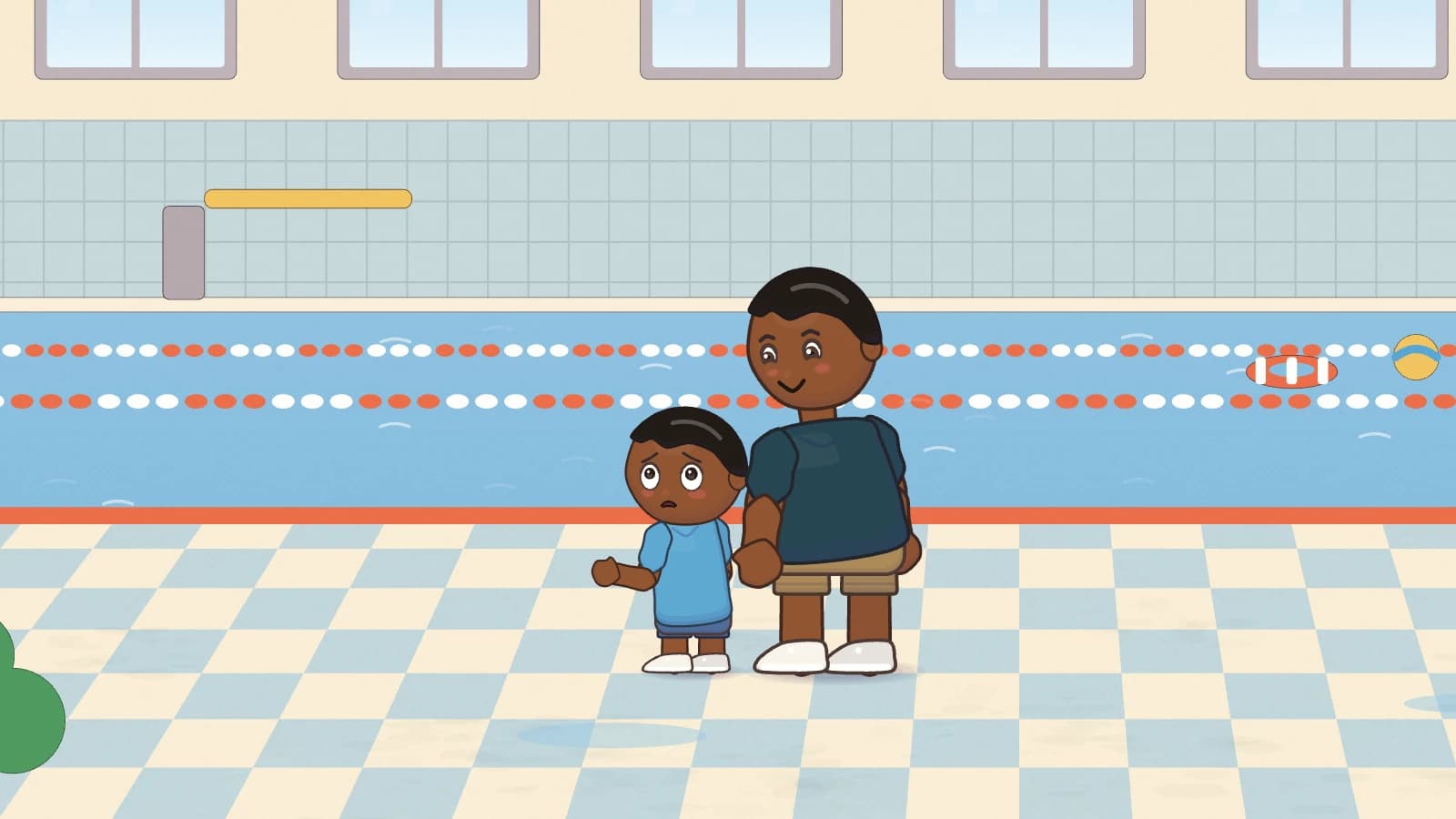
Noah and the High Diving Board
For weeks, Noah has watched the big kids jump off the high dive. Today he climbs the ladder… but from up there, the water looks so far away.Ages 4 to 85-minute read6-minute listen- Teaching kids values through stories (without the lecture)Sharing, courage, honesty: how stories help you talk about values with your child without lecturing, plus simple questions that get kids thinking.
- Stories about self-confidence for kids: trying, slipping up, and trying again“I’m bad at everything”: what to say, how to help your child try, slip up, and try again, plus a shoelace story and questions about self-confidence.
- Stories for kids who are scared of the darkA calm routine, a night-light, words to name the fear: ideas and a story to help you talk with your child about being scared of the dark, without teasing.